Agent Access Security Broker
The governance layer for AI coding agents. Unbound helps enterprises discover AI coding agents, understand their risk, and enforce guardrails over what those agents can see, touch, and do.
Works across the tools your teams already use
Deploy via Jamf, Intune, JumpCloud, or Kandji. Governance starts before standardization is complete.
AI coding agents changed the security question
This is no longer just about which model a developer prefers. It is about what the agent can do with enterprise permissions: edit files, run terminal commands, call MCP tools, query internal systems, and take multi-step actions in real time.
What is an Agent Access Security Broker?
An AASB is the control layer between AI coding agents and the tools, systems, files, and actions they can access. Like CASB created visibility and control for cloud apps, AASB creates visibility, risk analysis, and policy enforcement for agent access across IDEs, terminals, MCP servers, internal tools, data, and infrastructure.
If CASB secured employee access to cloud apps, AASB secures agent access to tools, files, systems, and actions.
Discover
Inventory agents, MCP servers, sub-agents, prompt/policy rules, and risky settings.
Assess
Surface risky autonomy, unsafe permissions, dangerous connectors, and high-risk usage patterns.
Enforce
Audit, warn, block, or require approval for risky actions and sensitive data flows.
Why existing controls are necessary but not enough
AppSec, IAM, endpoint controls, and AI gateways still matter. The problem is that none of them were built to govern live agent behavior inside AI coding workflows. AASB complements these layers by focusing on what the agent can access and do during the session.
| Existing Control | What It Does Well | Where It Falls Short |
|---|---|---|
| AppSec / Code Scanning | Finds vulnerabilities and policy issues in code artifacts | Does not govern live terminal commands, MCP tool invocations, or agent permissions while work is happening |
| IAM / PAM | Controls identities, credentials, and privileged account access | Does not understand agent autonomy settings, sub-agents, MCP servers, or in-session agent intent |
| EDR / Endpoint | Sees processes and device activity | Cannot explain why the agent acted, which policy should apply, or whether the action was agent-approved vs. user-approved |
| AI Gateway | Routes and secures model traffic | May not see IDE posture, terminal behavior, MCP actions, or risky configuration states inside coding tools |
| CASB / DLP | Governs SaaS access and some data movement | Not designed for IDE/CLI workflows, agent permissions, or approval logic around live coding-tool actions |
A new control layer is needed — one built specifically for AI coding agent governance.
What happens if you do not solve for AASB?
Without a dedicated control plane, organizations inherit a compound failure mode: more autonomy, more connectors, more hidden configurations, and less visibility into what is happening in real time.
Hidden AI sprawl
Security cannot confidently answer which agents, versions, MCP servers, and rule sets are in use.
Excessive autonomy
Auto-approve, unsafe allowlists, and broad permissions let agents act faster than reviewers can react.
Connector risk
Unsanctioned MCP servers and external tools expand the blast radius beyond the IDE.
Runtime risk
Destructive commands or sensitive operations happen before post-commit or after-the-fact controls can help.
Weak evidence
Investigations and compliance reviews slow down when there is no reliable record of actions, approvals, and policy outcomes.
Productivity backlash
Security falls back to blanket restrictions, and developers route around them.
The answer is not to ban AI coding agents. The answer is to govern them.
How Unbound operationalizes AASB
Unbound gives security and engineering a shared control plane across discovery, posture, runtime governance, analytics, and rollout.
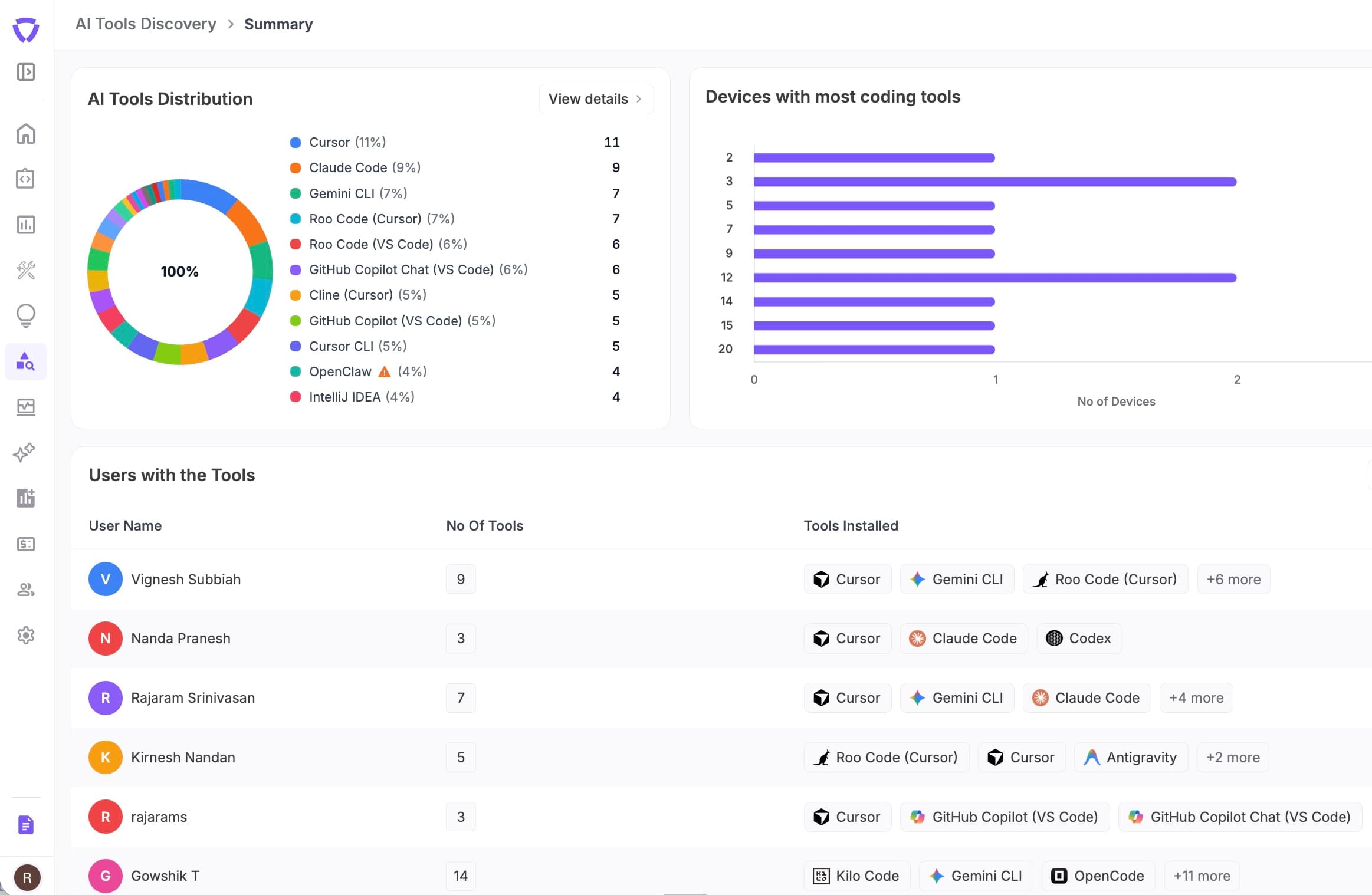
Discover the real estate
Inventory AI coding tools, MCP servers, sub-agents, agent rules, and risky configurations across the organization.
- ✓Detect Cursor, Claude Code, Copilot, Cline, and 20+ tools
- ✓Enumerate MCP servers and their configurations
- ✓Map agent rules and extension inventory
- ✓Track installation drift over time
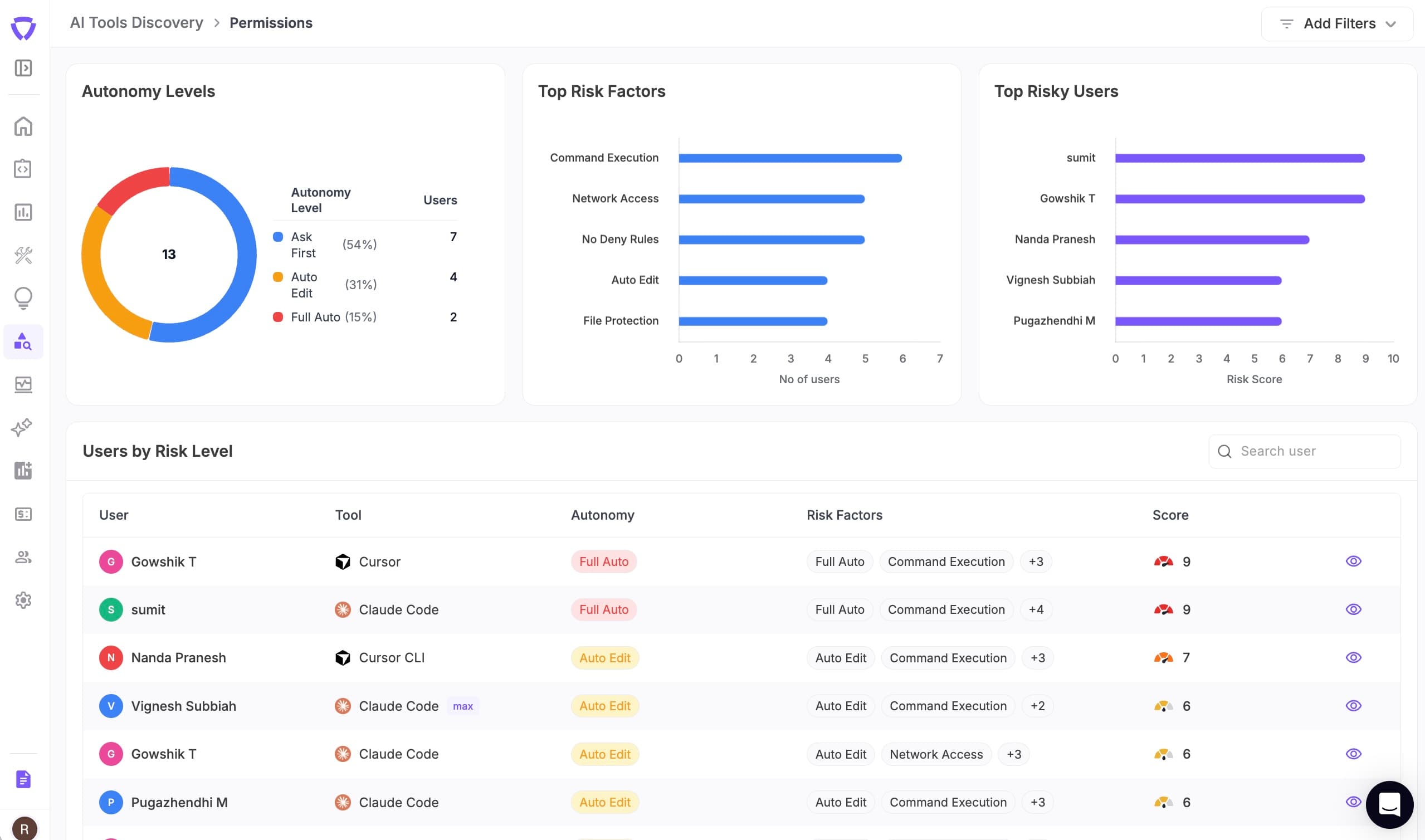
See live agent behavior
Monitor terminal runs and MCP actions by user, application, and tool while work is happening. Benchmark against peer organizations.
- ✓Per-developer security posture scores
- ✓Risky MCP server connection alerts
- ✓Autonomy and permission risk analysis
- ✓Trend tracking and drift detection
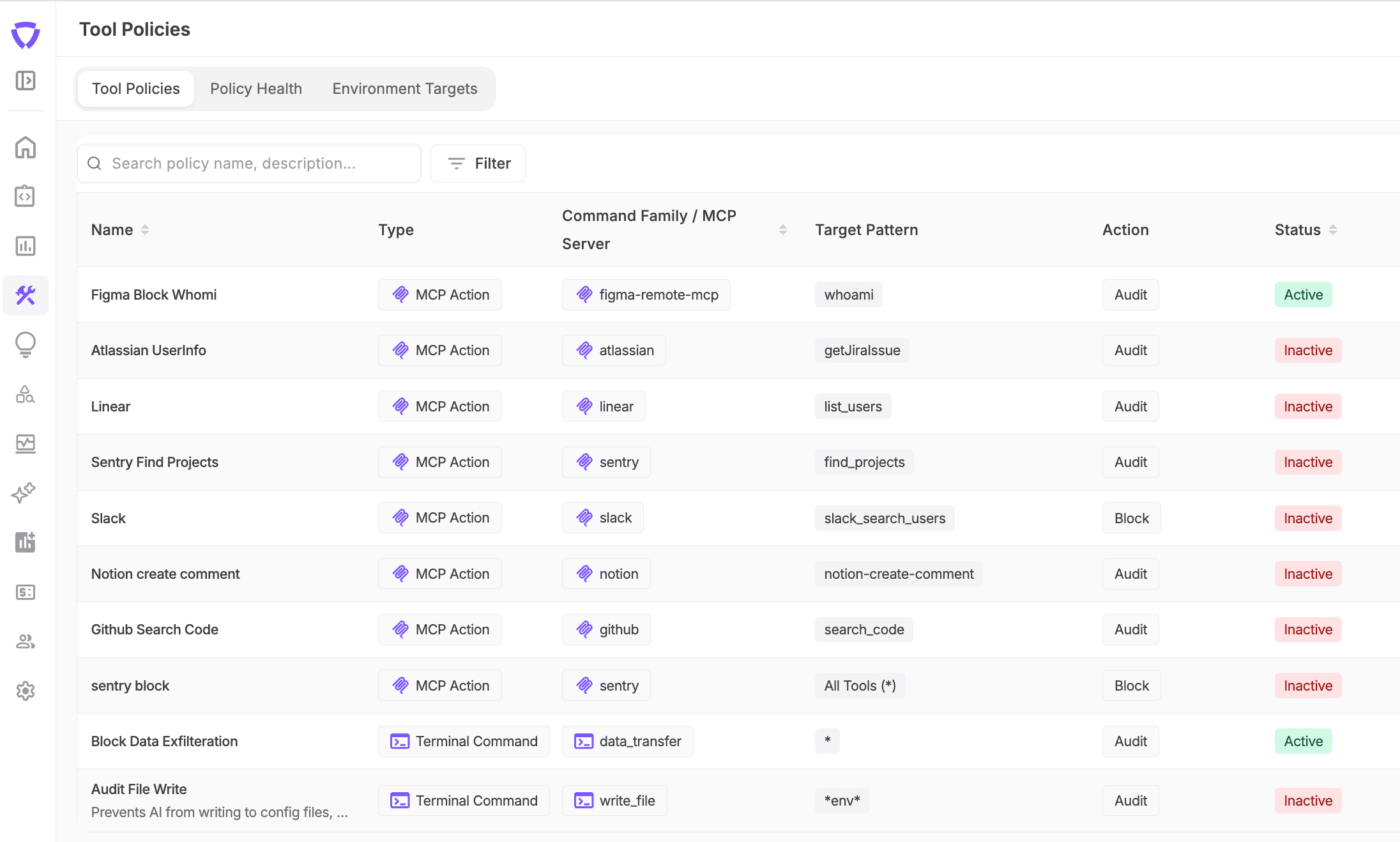
Enforce guardrails where risk happens
Audit, warn, block, or require approval for destructive commands, unsafe MCP use, unsanctioned tools, and sensitive data movement.
- ✓Terminal command allow/deny with semantic parsing
- ✓MCP server connection and action policies
- ✓Approval workflows for high-risk operations
- ✓Full audit log of every agent action
Standardize good usage
Use centralized policy, recommendations, and coaching insights to spread safe, effective agent workflows across teams.
Roll out without rip-and-replace
Integrate with existing coding tools and deploy with MDM workflows so governance can start before standardization is complete.
Keep the governed path reliable
Use routing, redundancy, and error handling so security controls do not become a reason to bypass the platform.
Works with the tools teams already use
Unbound meets developers where they already work. Teams can start in visibility mode, then move to warnings, approvals, and enforcement as policy matures.
Connect & Discover
Connect or discover the AI coding tools already in use across your engineering org.
Baseline & Assess
Baseline risky configurations, MCP servers, and user patterns. Score posture against benchmarks.
Progressive Policy
Turn on progressive policies: audit first, then warn, approve, or block as confidence grows.
Frequently asked questions
Common questions about the AASB category and Unbound.
Make AI coding agent adoption governable
Start with a governance assessment, see the discovery dashboard, or download the whitepaper to align security and engineering on the AASB model.